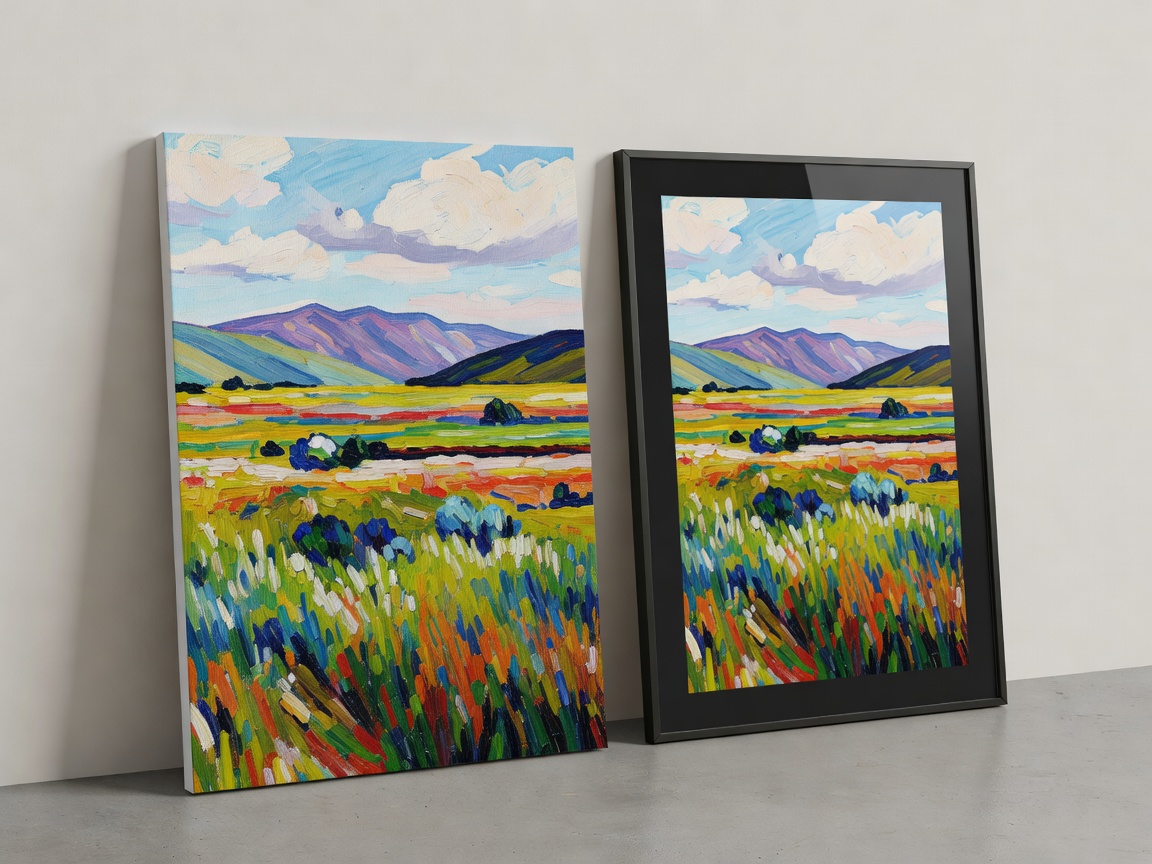
The decision between stretched canvas and framed prints fundamentally alters the architectural presentation of an artwork. It is not merely a matter of surface aesthetics, but a structural choice that affects depth, lighting interplay, and spatial geometry within a room.
The Mechanics of Stretched Canvas
Canvas prints are produced by rendering an image onto a fabric substrate—typically a cotton or polyester blend—which is then stretched over a rigid internal framework known as stretcher bars. The defining characteristic of canvas is its frameless presentation and physical protrusion from the wall plane.
- Textural interference: The weave of the canvas introduces a tactile element that interacts with ambient light, diffusing hard reflections.
- Dimensionality: Canvas naturally stands off the wall. Standard stretcher bars measure 0.75 inches to 1.5 inches in depth, creating natural drop shadows that anchor the piece to the wall geometry.
- Edge treatments: The image can be mirrored, wrapped, or finished with a solid color along the edges, dictating how the piece is viewed from oblique angles.
The Architecture of Framed Prints
Framed prints isolate the artwork behind a protective glazing (glass or acrylic) and confine it within a rigid boundary. This presentation method introduces secondary design elements: the matting and the frame molding.
Frames act as visual delineators. In environments with heavy architectural details—such as wainscoting, pronounced baseboards, or complex shelving—a framed print introduces structural repetition. The presence of matting provides negative space, focusing the viewer’s eye and creating a transition zone between the environment and the artwork.
Comparative Variables: Glare and Weight
One of the most critical functional differences between the two formats is light interaction. Framed prints, unless fitted with specialized museum-grade acrylic or anti-reflective glass, will suffer from glare. In highly fenestrated rooms, a standard glass frame can become a mirror, obscuring the print entirely during peak daylight hours.
Canvas circumvents this issue. The matte surface and textured weave absorb light rather than reflecting it, making canvas structurally superior for rooms with intense, direct natural light or complex artificial lighting arrays.
| Characteristic | Stretched Canvas | Framed Print (Glass/Acrylic) |
|---|---|---|
| Weight Density | Low (Hollow center) | High (Solid glazing & frame) |
| Glare & Reflection | Minimal (Matte surface) | High (Unless treated) |
| Edge Boundary | Soft / Frameless | Hard / Delineated |
| Moisture Tolerance | Moderate (Prone to sagging) | High (If properly sealed) |
Installation and Hardware
Structural integrity dictates the hanging mechanisms. Canvas, being lightweight due to its hollow center, can often be supported by standard drywall hooks or even heavy-duty adhesive strips. The strain on the wall substrate is minimal.
Conversely, large-scale framed prints require aggressive anchoring. The combined weight of thick paper stock, heavy glass, and solid wood or metal framing necessitates structural cleats or toggles driven directly into wall studs. Failure to account for this weight can lead to catastrophic hardware failure.
Conclusion: Selection Criteria
Select canvas when the objective is integration—allowing the art to exist in the space without the barrier of glass, minimizing glare, and maintaining a lightweight footprint. Choose framed prints when the objective is isolation and elevation—using the geometry of the frame and mat to draw the eye, protect archival paper stocks, and introduce rigid architectural lines onto the wall surface.