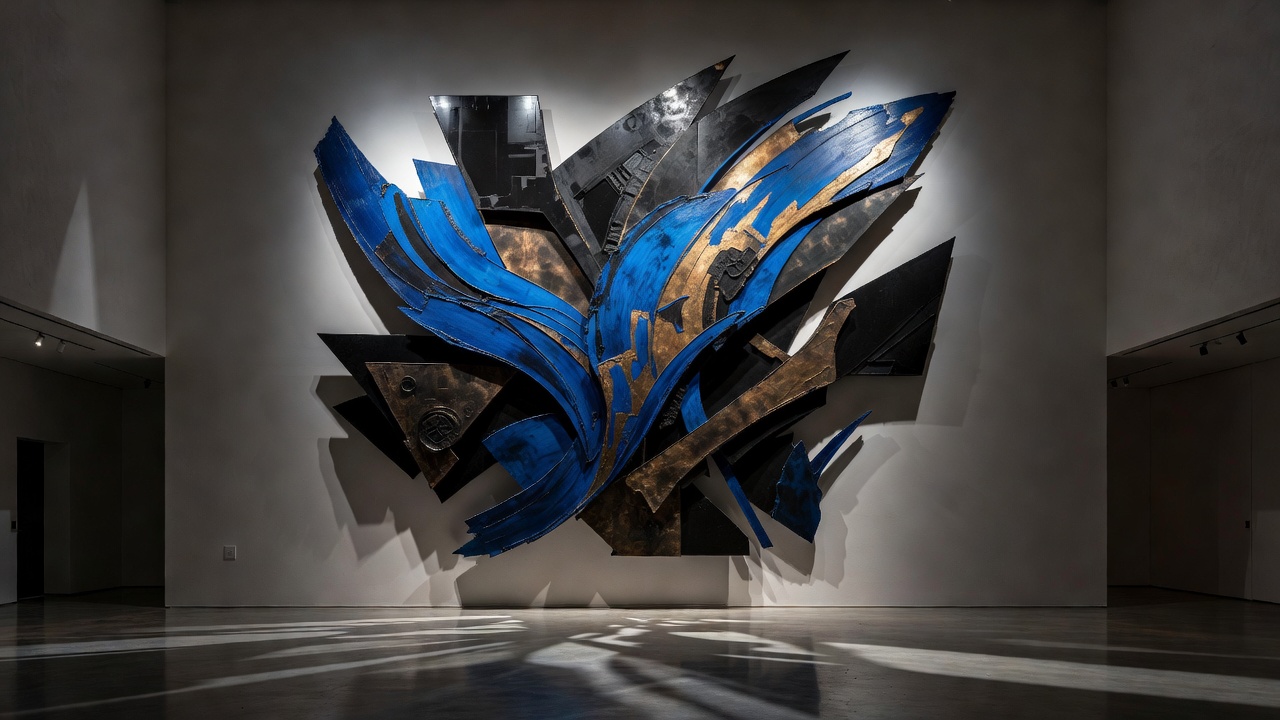
Oversized art commands authority. Defined generally as any piece exceeding 40 inches on a single axis, large-scale statement pieces abandon the subtlety of smaller frames in favor of architectural dominance. Installing artwork of this magnitude requires rigorous attention to proportion, hardware physics, and dedicated lighting.
Proportion and Placement Formulas
A massive piece of art placed incorrectly will visually crush the furniture beneath it or make a wall feel claustrophobic. The structural rule for large-scale placement centers on the "two-thirds" ratio.
- Over Furniture: When mounting above a sofa, credenza, or headboard, the width of the artwork should span between 50% and 75% of the furniture's width. Exceeding 100% creates top-heavy visual instability.
- Blank Walls: On an empty wall, the artwork should occupy roughly 60% of the available wall space horizontally, leaving generous negative space on either side to frame the piece naturally.
- Height: Because oversized pieces extend further up and down the wall, standard eye-level rules (57 inches on center) may need adjustment. Ensure the bottom edge clears furniture by at least 6 to 8 inches.
The Physics of Installation
Large-scale framed pieces, particularly those utilizing glass and solid wood molding, routinely exceed 50 pounds. Standard picture wire and single-point drywall hooks are unacceptable for this weight class.
The structural solution is the French cleat. A French cleat system involves two interlocking extruded aluminum tracks. One track is screwed directly into wall studs across its entire length; the second track is affixed to the top rear frame of the artwork. This distributes the weight linearly across multiple studs rather than concentrating it on a single point of failure, ensuring the piece remains perfectly level over time.
| Mounting Hardware | Weight Capacity | Best Use Case |
|---|---|---|
| Drywall Anchors (Toggle) | Up to 40 lbs | Large unstretched canvases, lightweight materials. |
| D-Rings with Stud Screws | Up to 60 lbs | Medium-heavy framed prints with acrylic. |
| French Cleat System | 100+ lbs | Oversized heavy framing, glass glazing, mirrors. |
Lighting the Canvas
A statement piece loses its structural impact if improperly illuminated. Ambient room lighting is rarely sufficient to wash a 60-inch canvas evenly.
Directional lighting is required. Ceiling-mounted track fixtures or recessed adjustable gimbals should be aimed at a 30-degree angle toward the center of the artwork. This specific angle prevents a "hot spot" of glare at the top of the frame while minimizing long shadows cast by the frame molding. Alternatively, dedicated picture lights mounted to the frame or wall directly above the piece provide an intimate, gallery-style wash, provided the arm extends far enough to cover the vertical drop of the canvas.
Conclusion
Integrating large-scale statement art is an exercise in scale management. It demands precise calculations of wall geometry, adherence to load-bearing hardware principles, and specialized lighting. When executed structurally, an oversized piece ceases to be a decoration and becomes an integral component of the room’s architecture.